



Our Forest
Forestry >> Our Forest
The Menominee Forest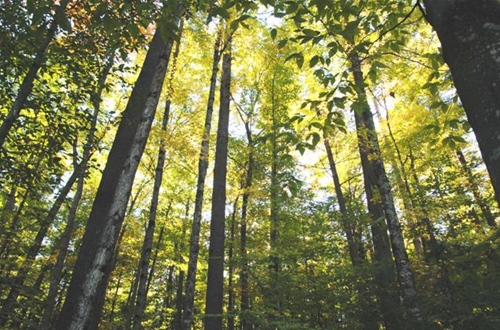
Due to its location at the northern cusp of the transitional "tension zone", which divides the state's central hardwood forest from the northern hardwood forest, the Menominee forest contains a higher diversity of tree species than forests found to its north or south. The diversity is demonstrated by thirteen forest cover types identified in the range of sites on this relatively small patch of forest.
The Menominee have one of the most diverse forests in the Midwest. Northern Hardwood is the most common forest cover type in terms of acreage, covering approximately 32% of the forest. This is followed by White Pine (16%), Swamp Conifers (10%), Aspen (9%), mid-tolerant hardwoods (7%), and Red Oak (6%). By sawlog volume, Sugar Maple is the most common species (23%), followed by Hemlock (22%), White Pine (19%), and Red Oak (8%).
MTE Lumber is a lumber and wood product provider capable of responsibly harvesting timber from these wide varieties of species.
Menominee Forest Species List
*Despite record freezing temperatures in the Midwest this Winter, Emerald Ash Borers (EAB) are still thriving in pockets of your precious ash trees, which could mean costly treatment plans in the future. Read the full article on EAB and freezing weather to see how you can combat these parasites before it's too late.
Tree Groupings
Ecologists usually group plants and trees often found together into separate communities. These plant communities make up the different forest types on the Reservation. These differ from site to site because of variations in sunlight, moisture, soil type, and climate. Plants with similar site requirements generally live together. Animals finding the food and shelter they like will make use of the community in order to live.
The reservation boundary encompasses just over 235,000 acres with about 233,000 acres in trust status. Of this, about 217,000 acres are commercial forested acres, the majority of which is under active forest management.
Why is the Menominee forest recognized as one of the finest examples of forest management in the Lake States?
- Adaptive sustained yield procedures developed over decades. The Tribe uses a CFI system to monitor the growth and health of the forest and a harvest control based on silvicultural prescriptions versus predicted growth estimates.
- "Open door" policy of technical exchange with federal, state, university, and industrial forestry professionals resulting in the implementation of "cutting edge" forestry practices.
- Forestry staff time is devoted primarily to field operations vs. extensive office time.
- "What's best for the forest?" philosophy. Agency provincialism has been replaced with cooperation, and the forestry staff of MTE, DNR, and BIA are consolidated under one office complex.
- Menominee does not have written prescriptions for non-consumptive uses of the forest. The tribe has come to the understanding that good state-of-the-art forestry, including diversity, produces good wildlife habitat, water quality, and aesthetics.
- Aesthetics is Menominee's untold story. Our forests and rivers are some of the most pristine looking in the Lake States.
- Approximately 75,000 cords of pulpwood and 14 million board feet of saw timber are harvested annually.